Fun Facts About the Djembe

Mason O'Donnell
| 10-04-2026
 · Art Team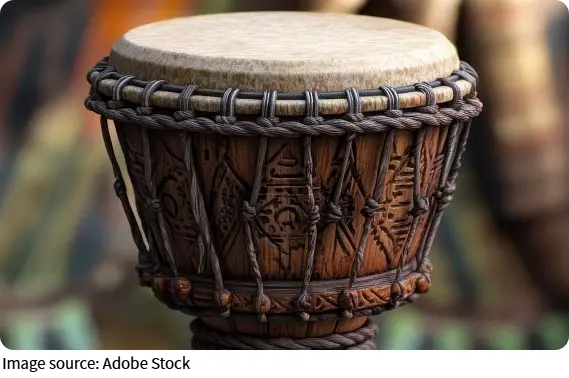
Pick up a djembe for the first time and it feels deceptively simple — a wooden shell, an animal skin stretched across the top, and nothing between your hands and the sound but air.
No keys, no strings, no mechanical parts. And yet this drum is capable of producing an extraordinary range of tones, has traveled from small West African villages to concert stages on every continent, and carries a name that contains an entire philosophy inside it.
The djembe is far more interesting than it looks.
The Name Itself Is a Complete Sentence
The word djembe comes from the Bambara phrase "Anke djé, anke bé" — which translates roughly as "everyone gather together in peace." That phrase was condensed over generations into a single word that became the name of the instrument itself. This means that every time someone says the name of this drum, they are repeating an ancient call for community and unity, whether they know it or not.
The djembe originated among the Mandé peoples of West Africa, in the region that now encompasses Guinea, Mali, Burkina Faso, and Senegal. Its creation is traditionally attributed to the blacksmith caste — a group considered to possess special spiritual power within Mandé society. The earliest djembes are believed to date back to the Mali Empire, placing the instrument's origins somewhere around the 12th or 13th century.
Three Distinct Sounds From One Drum
What makes the djembe technically remarkable is its ability to produce three fundamentally different tones from a single drumhead, each requiring a different hand position and striking technique.
1. The bass tone is produced by striking the center of the drumhead with a flat, relaxed hand. It creates a deep, resonant sound that carries across long distances and forms the rhythmic foundation of an ensemble.
2. The tone is produced by striking near the edge of the drumhead with the fingers held together and slightly curved. It produces a clear, mid-range sound that sits above the bass and carries melodic information within the rhythm.
3. The slap is the most complex of the three. Produced by striking the edge of the drumhead with the fingers spread and the hand moving in a snapping motion, it creates a sharp, high-pitched snap that cuts through other sounds and provides rhythmic accents.
Master players combine these three voices in rapid succession, creating what sounds to untrained ears like multiple drummers playing simultaneously. In reality, it is a single pair of hands doing all of it.
The Shell Is Carved From a Single Tree
A traditional djembe shell is carved entirely from a single piece of hardwood — not assembled from multiple pieces but hollowed out from one solid trunk. The most prized wood for this purpose is the Gueni tree, also known as the Lenke tree, which is considered sacred in parts of West Africa. Other commonly used woods include Djalla and Gele.
The goblet shape of the shell is not merely aesthetic. The wide upper bowl amplifies the vibration of the drumhead, while the narrow lower opening acts as a port that projects sound downward and outward simultaneously. This design allows the djembe to produce both power and clarity — a combination that simpler drum designs struggle to achieve at the same volume.
The drumhead itself is traditionally made from the skin of a goat, chosen for its thinness and responsiveness. The skin is stretched over the top of the shell and held in tension by a system of rings and vertical ropes that run the length of the instrument. Tuning is adjusted by tightening or loosening this rope system — a process that requires both skill and patience.
It Was Once Restricted by Social Role
In traditional Mandé society, the djembe was not simply a musical instrument available to anyone who wanted to play it. It was a ceremonial object connected to specific social functions — healing rituals, initiation ceremonies, harvest celebrations, and the accompanying of griots, the professional storytellers and spoken historians who preserved community memory across generations.
Playing was often the domain of designated musicians who trained extensively within their community. The knowledge of rhythms was considered sacred and was passed from teacher to student through direct transmission, not written notation. Many traditional rhythms carry specific ceremonial meanings and were only performed in precise ritual contexts.
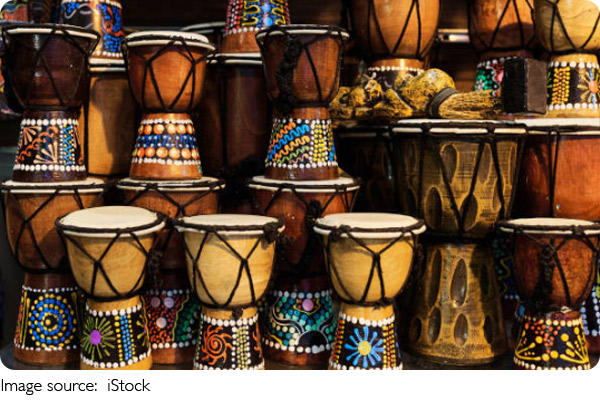
The djembe has traveled an extraordinary distance from those ceremonial origins — from sacred village gatherings to international music festivals, university percussion programs, and community drum circles in cities far removed from West Africa. That journey says something about the instrument's fundamental power. A drum that was designed to call people together, it turns out, keeps doing exactly that wherever it goes.